With the approaching release of ‘Mulan‘ on the 27 March 2020 by Disney, it seems relevant to take a look at the industrial reasons behind the company’s decision to commission live action remakes of their animated films.
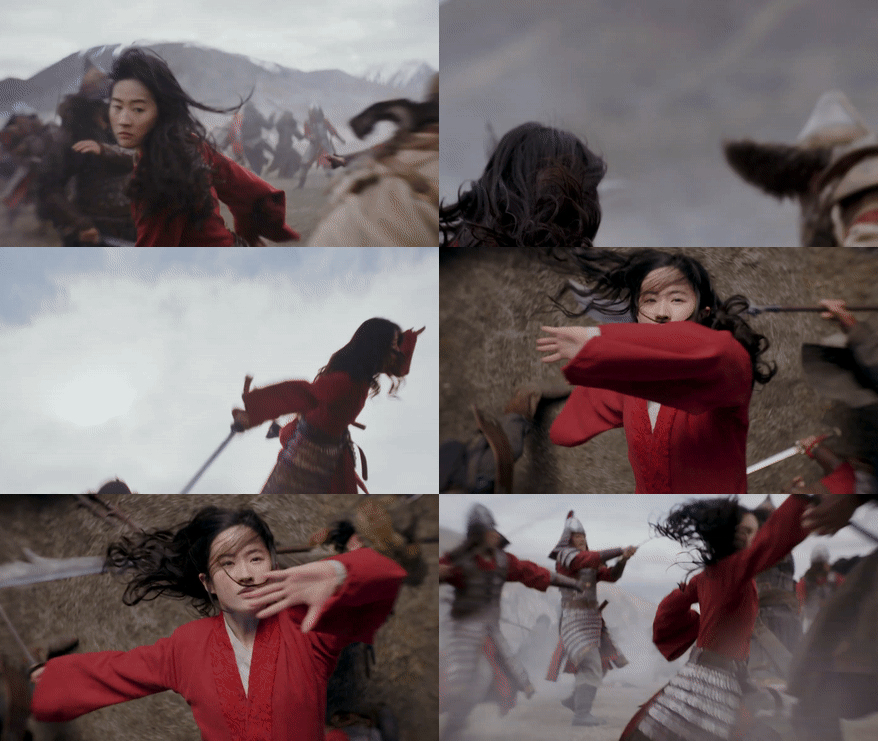
Since ‘Maleficent‘ (2014, Robert Stromberg), Disney started producing animated live action remakes every year, starting with ‘Cinderella‘ (2015, Kenneth Branagh), followed by ‘The Jungle book‘ (2016, John Favreau), ‘Beauty and the beast‘ (2017, Bill Condon), and ‘Christopher Robin‘ (2018, Marc Foster). Not an abnormal rate for the giant multinational mass media conglomerate.
However in 2019 Disney broke their all time record by producing five live actions within the same year: ‘Dumbo‘ (2019, Tim Burton), ‘Aladdin‘ (2019, Guy Ritchie), ‘The Lion King‘ (2019, Jon Favreau), ‘Maleficent 2‘ (2019, Joachim Ronning), and ‘Lady and the Tramp‘ (2019, Charlie Bean).
Why this sudden peak in commissioning live action remakes? Well, it is all about copyright, ownership and nostalgia.
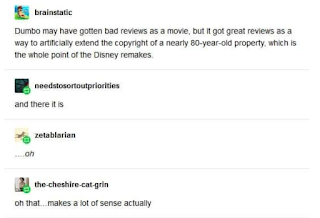
After Dumbo came out in March 2019, the audience felt like it was a way for Disney to extend their copyright over the story. While that’s not completely true because Disney never owned the copyright of the novels that their films originated from, according to copyright laws, it is not completely false either.
In 1976, the Sonny Bono Copyright Act was initiated, which extended the copyrights to a creative property from 50 years to 70 years for individual properties, or 95 years after publication for corporate work. In that aspect, every book published before 1950, are now part of the public domain and everyone can make movie and TV series adaptations from them.
As an example, the original ‘Treasure Island‘ novel by Robert Louis Stevenson went into public domain in 1944, 50 years after the publication of the novel according to the copyright laws prior to the 1976 Copyright Act. Disney releasing ‘Treasure Island‘ (1950, Byron Haskin) in 1950, a few years only after the copyrights of the film went into public domain, does not mean that they own the story. Indeed, a dozen other companies also produced version of Treasure Island such as ‘Treasure Island‘ (1990, Fraser Clarke Heston) Turner Pictures.
Why then keep making films about a story that anyone can copy or mimic?
While all film adaptations are based on the same source material, the production company that produces them own the familiar elements of the representation such as the songs, the set, or the costumes. An example is ‘The Wizard of Oz‘ (1938, Victor Fleming) where Warner Bros. owns the Red Ruby Slippers and the Yellow Brick Road which make the film iconic, and that now no on can mimic because they own it for 95 years after the film release according to Sonny Bono Copyright Act.
Then it’s just a matter of reminding the public who is doing it better than the others.
When ‘Mowgli: Legend of the Jungle‘ (2018, Andy Serkis) was produced by Warner Bros., Disney immediately commissioned a sequel to their Jungle Book suppose to come out in October 2020. Or when a Chinese version of Mulan, ‘Mulan: Rise of a Warrior‘ (2006, Jingle Ma) came out, Disney commissioned their own Mulan live action film. Finally with Netflix producing ‘The Little Mermaid‘ (2018, Blake Harris) to which Disney responded by commissioning a Little Mermaid live action to be directed by Robb Marshall.
Disney is commissioning so many live actions remakes because it needs to assert its ownership onto stories they have used as trademarks for their brand, and they need to do that before anyone else does.
However, is this emergency not too rushed for the audience to make sense of it and be beneficial?
 Léon Bodier