One of my friends told me something that made me want to write this article and I think it opens the argument quite well: « It’s self-wanking and we are supposed to take it and call it art because of eye shadow and nails. »
So, it took me a while to watch HBO Euphoria, and I eventually did because my sister put it on her iPad for our flight to Sri-Lanka. Which is odd because I was such a huge fan of Sam Lenvinson’s teen thriller “Assassination Nation”. And I knew from all the online press the show was getting that Euphoria had the same sort of signature style: glittery eyeshadow, powerful women, toxic masculinity, social media abuse, and an overall sense of unbridled American teenagerhood. Plus, I had a little guilty crush on Jacob Elorbi after watching the Kissing Booth (sue me). So why didn’t I immediately tune in when the show first came out?
Well. When you put aside the cinematography – which is undoubtedly one of the most beautiful thing that has blessed our screens – the show felt random. The synopsis on IMdB goes: “A look at life for a group of high school students as they grapple with issues of drugs, sex, and violence.” Which felt like it could the storyline of any other episode of Gossip Girl who at least made the effort to add some semblance of a mystery plot to the mix. But when Chuck Bass’ rape scene in season 1 came out, everyone drewthe line and dismissed his storylines from the rape onward feeling that the character’s violence would make it unjustifiable to keep watching the show (and I agree). Meanwhile a decade later, the same viewers were tuning in and praising Euphoria, a show defining its storyline as: “teenagers grappling with sex, drugs, and violence” and nothing else.
To me that felt like trauma porn. “Trauma porn is any art or medium that exploits the trauma of another person most often for the act of getting a rise out of the viewer.” Which was probably the reason I hadn’t watched the show, becauseIt felt weird to me to go home after work, eat dinner and put on my TV to relax to teenagers being raped or ODing in their highschool bathroom. And nothing else. Ultimately what bothered me was that people were being entertained by a show only performing these issues of sexual, physical, and emotional violence. Hear me out, I am not against these topics being portrayed on mainstream TV (I love Skins, Skam, Misfits, The Society, Merli etc.). My issue arises when violence becomes the plot driving force and not a way to safely discuss these topics
But then, how could I have an informed opinion on the show before actually watching it?
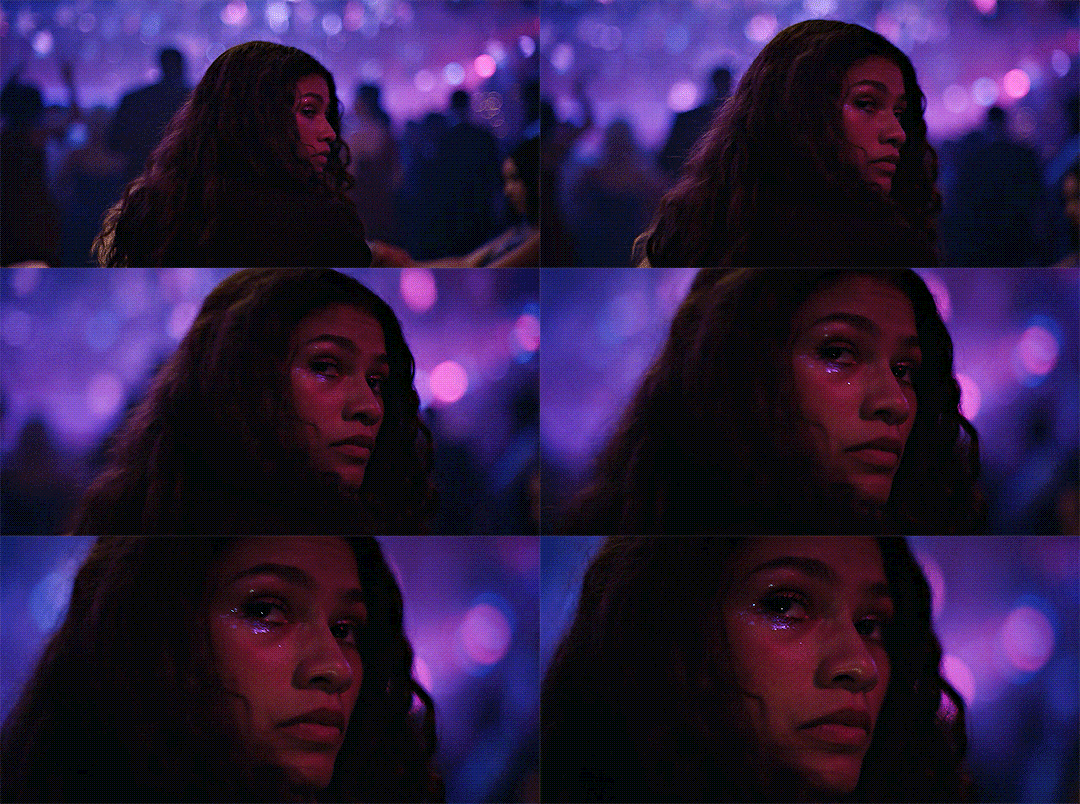
After binging both seasons of Euphoria, I realized Sam Levinson to be something of a genius. Every episode was more compelling than the next, I couldn’t tear my eyes from the screen and even ended up glued to my phone in the shower or on my walks to work. I couldn’t look away. But my opinion on the show didn’t change : it is a badly written TV series. Each scene has high entertainment value, each episode great teasing for the next – but so does any decent reality TV Show. In all honesty, the characters of Euphoria felt like they had as much character development and storyline resolution than the people on “Big Brother”.
The topic of sexual orientation being influenced by external factors and expressed later on during puberty is raised in the first half of season one through the character of Nate. The 8- year-old discovers his dad’s sex-tapes, and Nate is later shown distraught by his compulsion to keep pictures of penises on his phone despite having a girlfriend. From then on, the awareness of his father’s secret repeatedly prompts violent fits of rage. Which would be acceptable if it were to work toward a resolution serving the discussion of the issue raised – like to discuss the impact of exposition to sexual videos at a young age on adolescent psyche. Instead, it becomes clear early on that this anger is merely used for entertainment and to create interesting climatic scenes – such as the one of the fair, his bedroom meltdown, or when Fez beats him up. Which despite being great to watch, never comes to any conclusion or evolution for Nate’s character. The saddest thing is that they do create opportunities for it – like when he finally apologizes to Jules for his behavior, or when he has an open-hearted conversation with his mom about his upbringing. But one scene turns into a blaming competition, and the other ends up confirming he is the liar everyone knew he was. Potential for character growth clearly not being the goal here, Nate’s character and the hatred toward his father steaming from his trauma is only used throughout both seasons to explain his aggressive behavior for the creation of high-stake scenes.
Speaking of storylines justifying violence, the episode “You Who Cannot See, Think of Those Who Can” (season 2 episode 4) is a perfect example of this kind of damaging screenwriting. Ever wondered why Call rapes underage teens in creepy motels (while making child pornography videos) and constantly emotionally abuses his children? Oh, that’s because he was deprived his gay one true love and was forced into an unwanted pregnancy. Because apparently those of us who were made into straight relationships all turned into child-molesters. “But we are not excusing his behavior, we are just offering a background story to flesh out the characters. It’s your choice to read it as justification.”Unfortunately, that is the problem with setting a show in high school and making your characters 16-years-old: you target it to teenagers who often will just read a storyline as it is offered. When “13 reasons Why” season 3 came out, everyone flipped their computer and took over twitter insulting the showrunners (and actors) for giving Bryce Walker a redemption arc after he’d been trialed for Hannah Baker’s rape and all the terrible shit he’d done (that was actually disgusting). But Euphoria who discusses an entire redeeming arc for a child molester, suddenly gets a pass because the characters are hot, and the cinematography is pretty? The show should get the same treatment than 13RW which scores a 35% on rotten tomatoes (against 88% for Euphoria for those wondering).
As the screenwriters seem determined to expend on characters that don’t deserve to be, it appears they frequently forget others that do – or the topical conversation associated with their portrayal. The first season lays down the topic of abuse within the relationship (and all the good stuff that comes with it) as Maddy is being physically and verbally abused byNate at the town fair. It continues seamlessly in the second when she ponders if she should get back with him or not. Many studies show that victims of abuse go back multiple times to their abusers before truly leaving them: (https://safespaceworkplace.com/2017/03/15/take-seven-times-leave-abusive-relationship/). I was very excited to see the evolution and discussion of an issue extremely relevant and important in our current socio-political context. But before Maddy has time to actually make a decision, Nate once again becomes violent by threatening her with a gun. Alexa Demie’s brilliant acting just isn’t enough to save Maddy’s character (still one of the best on the show) from being overshadowed by Nate’s storylines. Many other plot lines that speak to a wider audience (Jules’s gender identity, Cassie’s relationship toward woman’s identity, Rue’s drug abuse, etc.) are left to focus on the violence of ‘straight white cis-men’ and how to properly find justification for it. Euphoria – while claiming contemporary relevance – doesn’t actually seek to discuss topics that our youth identifies with. The script merely uses these issues to warrant the sexual, emotional, andphysical violence of these men toward the creation of the most entertaining and visually appealing scenes possible.
Most often against women and Queer characters.
While Nate and Cal get more screen time, some of these characters seem doomed to become increasingly 2D and more specifically in the way they are being sexualized on the show. First there is the portrayal of Jules which continues Sam Levinson’s belief that trans character are only attractive when represented by skinny straight white woman. Fact proven later on when the writers seem to get bored with her just as her lesbian plot with Rue evolves (if you still don’t believe me, go watch Assassination Nation). But fading in the background, Jules lets another character with its own set of representation issues become the driving force of the show: Cassie Howard. Dawson Casting a show is a problem present on TV since the 20’s. ” It is an observed cultural phenomenon and movie trope in film and television in which many of the actors appear and are really much older than the characters they portray“. Ultimately, who can blame Euphoria for being stuck in the Hollywoodian belief that 16-year-old teenager need to have abs, a beard and D cup bra size. It is merely one among many others (…Riverdale…). But season 2 manages to replace Jules with the only other clearly cute and compliant woman on the show. Someone who just like her doesn’t seem to be able to have an opinion or do anything without a grown man telling her. Sorry to say that even Sydney Sweenie award worthy performance can’t save that constant whining. And accentuating the childlike character traits of sexualized actresses already playing younger parts feels uncomfortably like a legal way for the show to fulfil their Fetich. It is clear the high school trope will remain a fan favorite till the end of time, but I’m not sure Euphoria could have been forgiven even if it had been set in college. Sam Lenvinson biased sexualization of his character should send him to a psychiatrist, and definitely not be portrayed on HBO. Still wondering why he wanted to redeem Nate and Cal so much?
HBO remains a titan in terms of producing shows that will go down in history. And ‘Euphoria’’s beautiful filming techniques, great soundtrack and incredible acting will surely secure its position on the podium. Some of the issues pointed out in this article can be supplemented to decades of Hollywood cinema reinforcing biased concepts (Dawson casting, high school trope) that showrunners would now rather continue than risk their own show not to sell (cowardly but utlimately understandable). On the other hand, most of the other issues in Euphoria are due to the current unbridled freedom of speech mainstream TV is seeing after coming out of the production channels censorship that took place until the 80’s-90’s. Which I personally support as it allows for a multitude of voices to create content where any audience can find something they need to see. But it also means letting anyone’s damaging screenwriting have the possibility to become the most influential piece of audio-visual content in the world without question. As this freedom of speech makes it difficult to force creators to follow a baseline of moral codes depending on the audience they target – at least professional award shows should remain impartial to media praise. In my opinion, content prizes should sorely be based on the opinion of professionals, and not what public opinion has to say about it – which has been lacking in the recent years (example with ‘Baby Boss’ being selected at the Oscars against a forgotten ‘A silent voice’ the same year). Online platforms already give the possibility for free discussion, so in this instance award shows could then give audiences the means to be formally educated on the content they watch and the impacts it has on them.
THAT’S ALL FOR TODAY! What show would you like me to do next?
Thanks Zama for the inspiration !
 Léon Bodier